


UNM Department of Chemistry and Chemical Biology
Offering a broad range of disciplines, UNM's Department of Chemistry and Chemical Biology specializes in Biological Chemistry, Catalysis, and Electronic and Photonic Materials.
As the flagship university for the state of New Mexico, UNM enjoys collaborative research opportunities with Sandia National Laboratory, Los Alamos National Laboratory and the Air Force Research Laboratory Space Vehicles Directorate.
Research Highlights

Molecular Optomechanics Induced Hybrid Properties in Soft Materials Filled Plasmonic Nanocavities
Bisweswar Patra, Bijesh Kafle, and Terefe G. Habteyes report that the optomechanical interaction between nanocavity plasmons and molecular vibrations can result in interfacial phenomena that can be tailored for sensing and photocatalytic applications. For the first time, plasmon-vibration interaction can induce laser-plasmon detuning dependent plasmon resonance linewidth broadening, indicating energy transfer from the plasmon field to collective vibrational modes. The linewidth broadening accompanied by the large enhancement of the Raman scattering signal is observed as the laser-plasmon blue-detuning approaches the CH vibrational frequency of the molecular systems integrated in gold nanorod-on-mirror nanocavities.
Read more
Acceleration of 1,3-Dipolar Cycloadditions by Integration of Strain and Electronic Tuning
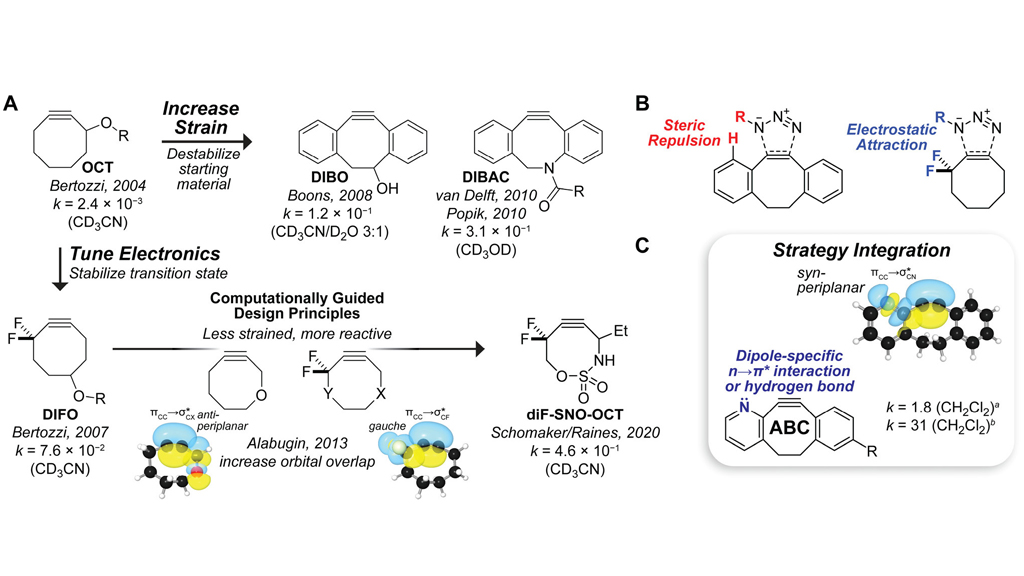
The discovery of "spring-loaded" chemoselective reactions has transformed chemical biology, polymer chemistry, materials chemistry, and allied fields. Jesús M. Dones, Nile S. Abularrage, Namrata Khanal, Brian Gold, and Ronald T. Raines published a paper describing the 1,3-dipolar cycloaddition between azides and alkynes providing new means to probe and control biological processes. A major challenge is to achieve high reaction rates with stable reagents. The optimization of alkynyl reagents has relied on two strategies: increasing strain and tuning electronics. In transition states, the nitrogen of 2-azabenzo-benzocyclooctyne (ABC) engages in an n→π* interaction with the C=O of α-azidoacetamides and forms a hydrogen bond with the N–H of α-diazoacetamides. They found that ABC reacts more quickly with α-azidoacetamides and α-diazoacetamides than its constitutional isomer, dibenzoazacyclooctyne (DIBAC).
Read more

Highly Accurate Chip-Based Resequencing of SARS-CoV-2 Clinical Samples
SARS-CoV-2 has infected over 128 million people worldwide, and until a vaccine is developed and widely disseminated, vigilant testing and contact tracing are the most effective ways to slow the spread of COVID-19. Typical clinical testing only confirms the presence or absence of the virus, but rather, a simple and rapid testing procedure that sequences the entire genome would be impactful and allow for tracing the spread of the virus and variants, as well as the appearance of new variants. However, traditional short read sequencing methods are time consuming and expensive. Herein, we describe a tiled genome array that we developed for rapid and inexpensive full viral genome resequencing, and we have applied our SARS-CoV-2-specific genome tiling array to rapidly and accurately resequence the viral genome from eight clinical samples.
Read more