Lab Chemical Spill Clean Up Procedures
How to Clean Up a Small Chemical Spill
The Laboratory Chemical Spill Clean Up Procedures were developed to give guidance to knowledgeable laboratory personnel on the safe and effective way to clean up small laboratory spills. If you have ANY questions or concerns about the spill clean up process, please contact the Safety Coordinator or EHS.
Chemical spills and accidents need to be minimized as much as possible. If a chemical spill should occur, a quick response with a stocked chemical spill kit will help minimize potential harm to personnel, equipment and laboratory space. Outlined below, is the minimal equipment required for a spill kit. You may add equipment to the kit, provided all personnel are proficient in its use. An example would be adding a metallic mercury spill kit.
Chemical Spill Kit Minimal Requirements
- Chemical Absorbent Powder (Universal, Acid Neutralizing, Caustic Neutralizing, or Solvent Spills)
- Plastic Scoop
- Polyethylene Bags (like Ziploc)
- Nitrile Gloves
- Splash Goggles
- Hazardous Waste Labels
Note that the majority of chemical spills can be prevented or minimized by:
- Maintaining a neat and organized work area;
- Performing a laboratory procedure review prior to conducting new experimental procedures;
- Storing liquid chemicals in secondary containment bins;
- Keeping reagent chemical containers sealed or closed at all times, except when removing contents;
- Ordering reagent chemicals in plastic or plastic coated glass containers whenever possible;
- Using secondary containment to store and move chemicals.
Types of Spills that CANNOT Be Handled by Laboratory Personnel
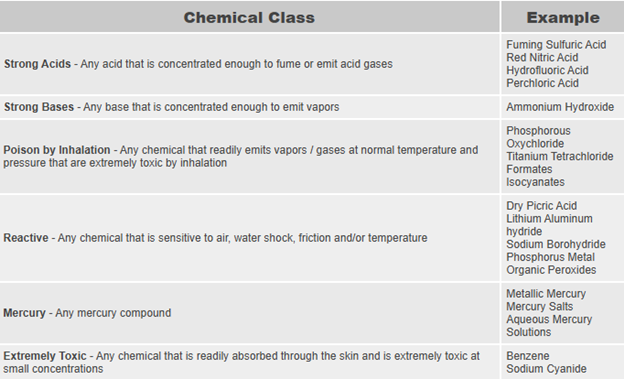
If the spill is too large for you to handle, involves more than 1 liter (L) of any hazardous material, involves materials listed in the table below; is a threat to personnel, students or the public; involves radioactive material; involves an infectious agent, call EHS for assistance.
Types of Spills that CAN Be Handled by Laboratory Personnel
Minor spills do not necessarily need the assistance of EHS. Laboratory workers who have had the proper training and possess the appropriate equipment can safely and effectively handle the majority of chemical spills that occur in the laboratory. In addition, spills involving multiple chemicals may pose various hazards. Always contact the Safety Coordinator if multiple chemicals are involved in a spill.
Labs can handle spills involving 1 L or less of liquid and one pound or less of a solid. If the spill is large, contact EHS to assist with the clean up. The following procedures are specific guidelines for using the recommended spill clean up materials. Contact the Safety Coordinator or EHS with any questions or concerns about proper spill clean-up practices.
General Spill Clean Up Procedures
In the event of a chemical spill, first decide if you are trained, knowledgeable and equipped to handle the incident. Immediately evacuate the lab and notify EHS if there is a possibility of an acute respiratory hazard present or if you need assistance to clean up the spill. Never proceed to clean up a spill if you do not know the hazards associated with the chemical or if you are unsure of how to clean up the spill. If anyone is injured or contaminated, immediately notify EHS and begin decontamination measures or first aid, if trained.
Don the personal protective equipment from the spill kit; splash goggles and gloves. Always ask a fellow researcher for assistance. They should also don splash goggles and gloves. Make sure that all forms of local exhaust, i.e. fume hoods, are operating. If broken glass is involved, do not pick it up with your gloved hands. Use the scoop or tongs to place it in the bag, then place the bag in a strong cardboard box or plastic container. Follow the procedures provided below based on the class and type of chemical.
All tools used in the clean up need to be decontaminated (plastic scoop, tongs, etc.). Remove all gross contamination with a wet paper towel. Dispose of the contaminated paper towels as waste. Rinse the tools off with copious amounts of water. Dispose of the gloves as waste. Dry the tools off and place back into the spill kit along with the splash goggles.
Liquid Spills
Choose the appropriate chemical spill powder from your kit based on whether the spill is an acid, caustic, or solvent spill. Spread the chemical spill powder over the spill starting with the edges first. This will help to confine the spill to a smaller area. Spread enough powder over the spill to completely cover the liquid. There should be no free liquid. Use the plastic scoop to ensure that the liquid was completely absorbed by the powder. Pick up the powder with the scoop and place in the polyethylene bag. Wipe the area down with a wet paper towel. Dispose of the paper towel with the waste generated from the spill clean up. Seal bag with tape and attach a completed hazardous waste sticker on the bag.
Solid Spills
Use the plastic scoop to place the spilled material into the polyethylene bag. Care should be taken so as not to create dust or cause the contaminated powder to become airborne. After the bulk of the material is cleaned up, wet a spill pad and wipe the area down. Place the pads into the polyethylene bag. Wipe the area down with a wet paper towel. Dispose of the paper towel with the waste generated from the spill clean up. Seal the bag with tape and attach a completed hazardous waste sticker on the bag.